Key Takeaways
- SAF is jet fuel made from renewable feedstocks instead of crude oil. It’s a drop-in replacement, usable in today’s aircraft and fuel systems without modification.
- SAF cuts lifecycle carbon emissions by roughly 80% compared to conventional jet fuel, and IATA estimates it could deliver up to 65% of the emissions reduction aviation needs to reach net zero by 2050.
- Global SAF supply is still tiny: IATA estimated in June 2026 that it would reach about 2.4 million tonnes this year, roughly 0.8% of total aviation fuel use, at a combined cost to airlines of roughly $4.3 billion.
- The UAE is building its own SAF industry directly: the Air-CRAFT consortium (ADNOC, Emirates, Etihad, Masdar, Boeing, and others) is developing local production, with a policy objective of about 700 million litres a year by 2030 and a voluntary goal of at least 1% local SAF in fuel supplied to UAE airlines by 2031.
Aviation accounts for roughly 2-3% of global CO₂ emissions, and with air travel demand still growing, cutting that share is one of the industry’s hardest decarbonization problems. Sustainable Aviation Fuel (SAF) is currently the most viable large-scale answer, and unlike hydrogen or electric aircraft, it works with the planes already flying today. This guide covers what SAF actually is, how it’s made, what it does and doesn’t solve yet, and where the UAE’s own SAF industry stands going into 2027.
What Is Sustainable Aviation Fuel?
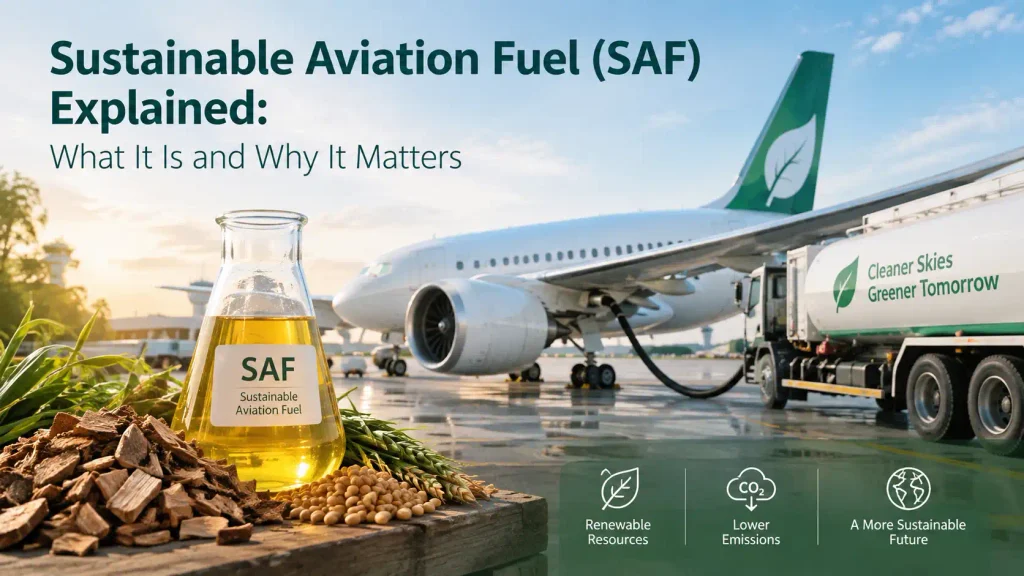
Sustainable Aviation Fuel is jet fuel produced from renewable and waste-based feedstocks rather than crude oil. It’s chemically similar enough to conventional Jet A-1 that it’s certified as a “drop-in” fuel: airlines can blend it into existing fuel supplies and use it in current aircraft engines and airport fueling infrastructure without modification.
SAF can be produced from a range of feedstocks, including used cooking oil, animal fats, agricultural and forestry residues, municipal solid waste, and algae-based and other advanced biomass sources. The point of using waste-derived feedstocks specifically is that the fuel doesn’t compete directly with food crops or virgin cropland the way some first-generation biofuels did.
How Is SAF Made?
Several certified production pathways exist, and most current SAF supply comes from one of them:
- HEFA (Hydroprocessed Esters and Fatty Acids): the dominant method today, processing fats, oils, and greases such as used cooking oil into jet fuel.
- Fischer-Tropsch (FT) synthesis: converts biomass or waste into liquid hydrocarbons through gasification and catalysis.
- Alcohol-to-Jet (ATJ): converts alcohols like ethanol or butanol into jet fuel through chemical synthesis.
- Power-to-Liquid (PtL): an emerging pathway that uses renewable electricity to synthesize fuel from water and captured carbon dioxide.
Each pathway is certified separately and produces fuel meeting the same specification as conventional Jet A-1, which is what allows blending without engine or infrastructure changes.
How Is SAF Certified for Use?
SAF isn’t approved on a marketing claim. Every production pathway has to pass ASTM D7566, the international specification for aviation turbine fuel containing synthesized hydrocarbons, before it can be blended into commercial jet fuel supply (SkyNRG, 2026). Qualifying under D7566 requires extensive testing to establish the maximum safe blend ratio for that specific pathway, typically somewhere between 10% and 50% depending on the feedstock and process. Once blended within its approved ratio, the resulting fuel automatically meets D1655, the standard Jet A/A-1 specification, which is the technical basis for calling it a true drop-in fuel rather than an alternative that needs separate handling.
How Much Does SAF Actually Reduce Emissions?
SAF cuts lifecycle carbon emissions by roughly 80% compared to conventional jet fuel, and newer feedstocks and pathways can push that figure above 90% (IATA, June 2026). That reduction is measured across the fuel’s full lifecycle, from feedstock production through combustion, not just at the point of burning it in an engine. IATA estimates SAF could contribute up to 65% of the total emissions reduction aviation needs to reach net zero CO₂ by 2050, more than any other single lever available to the industry today.
Sustainable Aviation Fuel in the UAE
The UAE’s General Policy for Sustainable Aviation Fuel, approved in October 2023, sets an objective of about 700 million litres of production a year by 2030 and a voluntary goal of at least 1% local SAF in the fuel supplied to UAE airlines at UAE airports by 2031. The first commercial plant, in Fujairah, began construction in November 2025. For the policy detail, the mandate under assessment, the projects and who is buying, see our guide to sustainable aviation fuel in the UAE.
Why Isn’t SAF Used More Widely Yet?
Despite the policy momentum, SAF still made up just 0.8% of global aviation fuel use in 2026, with production of roughly 2.4 million tonnes costing airlines a combined $4.3 billion (IATA, June 2026). Three factors explain the gap between ambition and volume.
Cost. SAF remains significantly more expensive to produce than conventional jet fuel, and that premium is passed through to airlines operating on thin margins, which is a large part of why the $4.3 billion IATA figure above covers barely 1% of global fuel volume. Supply. Refining and feedstock-processing capacity hasn’t scaled to match demand or policy targets, which is precisely the gap projects like the Abu Dhabi waste-to-SAF facility are meant to close by adding dedicated regional production rather than relying on imported supply. Feedstock competition. Renewable feedstocks like used cooking oil and agricultural residue are also sought by other industries, including road transport biofuels, which limits how much volume aviation can secure without new feedstock sources, such as municipal solid waste or power-to-liquid pathways, coming online at scale.
What This Means for Airlines and Operators
For an operator, the practical upside of SAF is that adoption doesn’t require new aircraft or new fueling infrastructure. It’s blended into existing Jet A-1 supply chains at certified ratios, so the transition is a supply and procurement decision rather than a fleet decision. That also means the timeline for adopting SAF is set by supply availability and contract terms, not by aircraft replacement cycles, which is a meaningfully faster path to lower emissions than waiting on next-generation aircraft or propulsion technology.
As UAE production capacity comes online through initiatives like Air-CRAFT, fuel suppliers already handling Jet A-1 procurement and logistics across the region are the ones positioned to bring SAF blending into standard supply contracts as volumes grow. For carriers and charter operators planning ahead of that shift, working with a supplier who already manages Jet A-1 sourcing and delivery at scale means SAF can be folded into an existing relationship rather than requiring a separate one, and any sustainability reporting or emissions commitments tied to fuel sourcing can be handled through the same procurement channel already in place.
Frequently Asked Questions
What is SAF made from?
Renewable and waste-based feedstocks, including used cooking oil, animal fats, agricultural and forestry residue, municipal solid waste, and algae-based biomass, depending on the production pathway used.
Does an aircraft need modification to use SAF?
No. SAF is certified as a drop-in fuel, meaning it can be blended into existing Jet A-1 supply and used in current aircraft engines and airport fueling systems without engine or infrastructure changes.
How much SAF is actually in use today?
Globally, SAF made up about 0.8% of total aviation fuel use in 2026, roughly 2.4 million tonnes, according to IATA. Adoption is growing but still far below the volumes needed to meet industry net-zero targets.
Is SAF produced in the UAE?
Not yet at commercial scale, but it’s in active development. The Air-CRAFT consortium and the Masdar-Tadweer waste-to-SAF facility in Abu Dhabi are working toward the UAE’s government target of 700 million litres of local SAF production annually.
Will SAF completely replace conventional jet fuel?
Not in the near term. SAF is currently blended with conventional jet fuel at certified ratios rather than used as a full replacement, and global supply constraints mean it will take years of capacity growth before blending ratios can increase significantly.
What certification does SAF need before it can be used?
SAF must be qualified under ASTM D7566 for its specific production pathway, which sets the maximum safe blend ratio with conventional jet fuel. Once blended within that ratio, it meets the D1655 Jet A/A-1 specification and is usable in existing aircraft and airport fueling infrastructure.
Bottom Line
SAF is the aviation industry’s most immediately usable tool for cutting emissions, an 80% lifecycle reduction available today without new aircraft or infrastructure. The constraint isn’t the technology, it’s supply, and that’s exactly where the UAE is investing directly through Air-CRAFT and Abu Dhabi’s planned waste-to-SAF facility. As that local supply comes online, procurement and blending will increasingly run through the same fuel supply relationships operators already rely on for Jet A-1.